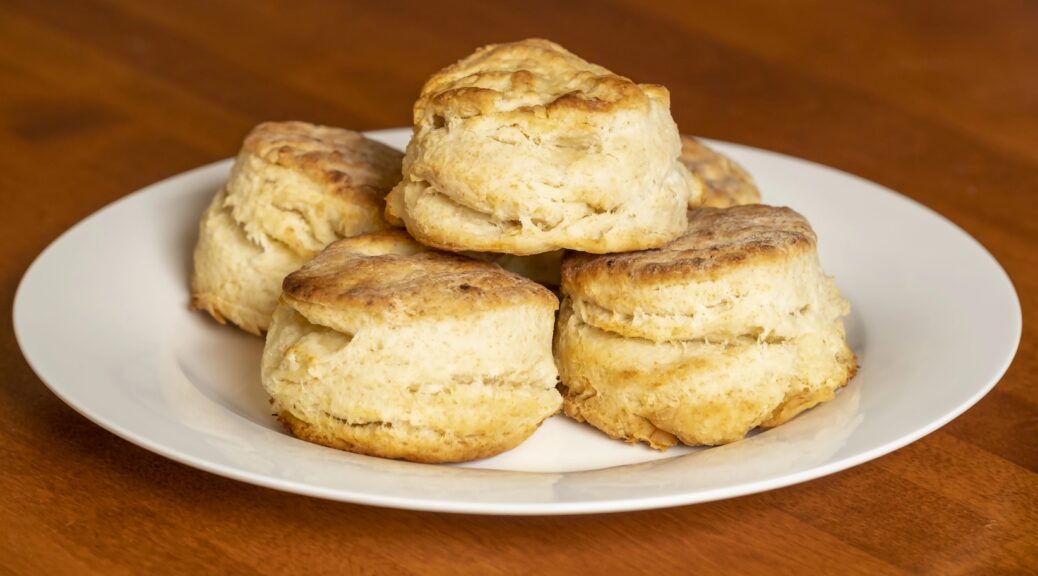
Making Homemade Biscuits
Bread was an important addition to most meals, and biscuits were especially popular for breakfast. All breads and biscuits had to be made from scratch. In addition, people cooked in wood burning stoves, which had no temperature gauge. You had to learn how to regulate the heat of coals and firewood for whatever you were baking. Cooking times were rarely provided for the same reason. Baking was definitely a skill to be learned through trial and error.
INFORMATION BELOW FROM 1800s COOKBOOKS
BISCUITS, ROLLS, MUFFINS, &C. GENERAL SUGGESTIONS.
Where any recipe calls for baking powder and you do not have it, you can use cream of tartar and soda*, in the proportion of one level teaspoon of soda to two of cream of tartar.
When the recipe calls for sweet milk* or cream, and you do not have it, you may use in place of it sour milk* or cream. In that case, baking powder or cream of tartar must not be used. Add baking-soda, using a level teaspoon to a quart of sour milk. The milk is always best when just turned, so that it is solid, and not sour enough to whey or to be watery.
When making biscuits or bread with baking powder or soda and cream of tartar, the oven should be prepared first. The dough must be handled quickly and put into the oven as soon as it becomes the proper lightness to ensure good success. If the oven is too slow*, the article baked will be heavy and hard.
As in beating cake, never stir ingredients into batter, but beat them in, by beating down from the bottom, and up, and over again. This laps the air into the batter which produces little air-cells and causes the dough to puff and swell as it comes in contact with the heat while cooking.
*soda – baking soda.
*sweet milk – whole milk; it was called sweet milk to distinguish it from buttermilk.
*sour milk – fresh whole milk that was left to ferment and sour by keeping it in a warm place for a day, often near a stove. Pasteurized milk (first introduced around 1895) may spoil rather than sour.
*slow oven – about 200-300 degrees Fahrenheit.
TO RENEW STALE ROLLS
To freshen stale biscuits or rolls, put them into a steamer for ten minutes, then dry them off in a hot oven. Or dip each roll for an instant in cold water and heat them crisp in the oven.
WARM BREAD FOR BREAKFAST
Dough after it has become once sufficiently raised and perfectly light, cannot afterwards be injured by setting aside in any cold place where it cannot freeze. Therefore, biscuits, rolls, &c., can be made late the day before wanted for breakfast. Prepare them ready for baking by molding them out late in the evening. Lay them a little apart on buttered tins. Cover the tins with a cloth, then fold around that a newspaper, so as to exclude the air, as that has a tendency to cause the crust to be hard and thick when baked.
The best place in summer is to place them in the ice-box,* then all you have to do in the morning (an hour before breakfast time, and while the oven is heating) is to bring them from the ice-box, take off the cloth and warm it, and place it over them again. Then set the tins in a warm place near the fire. This will give them time to rise and bake when needed.
If these directions are followed rightly, you will find it makes no difference with their lightness and goodness, and you can always be sure of warm raised biscuits for breakfast in one hour’s time.
*ice-box – a wooden box lined with tin or zinc, insulated with various materials, and containing a large block of ice. They were often called refrigerators until the electric refrigerator was invented.
SODA BISCUIT
To one quart of sifted flour, add one teaspoon soda, two teaspoons cream of tartar, and one teaspoon salt. Mix thoroughly and rub in two tablespoons of butter and wet with one pint of sweet milk. Bake in a quick* oven.
*hot or quick oven – about 400-450 degrees Fahrenheit.
BAKING POWDER BISCUIT
Take two pints of flour, butter the size of an egg,* three heaping teaspoons of baking powder and one teaspoon of salt. Make a soft dough of sweet milk* or water. Knead as little as possible, cut out with the usual biscuit-cutter and bake in rather a quick oven.
*size of an egg – one-fourth cup or two ounces.
SOUR MILK BISCUIT
Rub into a quart of sifted flour, a piece of butter the size of an egg and one teaspoon salt. Stir into this a pint of sour milk, dissolve one teaspoon of soda and stir into the milk just as you add it to the flour. Knead it up quickly, roll it out nearly half an inch thick and cut out with a biscuit-cutter. Bake immediately in a quick oven.
Very nice biscuit may be made with sour cream without the butter by the same process.
EGG BISCUIT
Sift together a quart of dry flour and three heaping teaspoons of baking powder. Rub into this thoroughly a piece of butter the size of an egg. Add two well-beaten eggs, a tablespoon of sugar, and a teaspoon of salt. Mix all together quickly into a soft dough, with one cup of milk, or more if needed. Roll out nearly half of an inch thick. Cut into biscuits, and bake immediately in a quick oven from fifteen to twenty minutes.
POTATO BISCUIT
Boil six good-sized potatoes with their jackets on. Take them out with a skimmer. Drain and squeeze with a towel to ensure being dry, then remove the skin, and mash them perfectly free from lumps. Add a tablespoon of butter, one egg and a pint of sweet milk. When cool, beat in one-half cup of yeast. Put in just enough flour to make a stiff dough. When this rises, make into small cakes. Let them rise the same as biscuit and bake a delicate brown.
This dough is very fine dropped into meat soups for pot-pie.
VINEGAR BISCUITS
Take two quarts of flour, one large tablespoon of lard or butter, one and one-half tablespoons of vinegar and one teaspoon of soda. Put the soda in the vinegar and stir it well. Stir in the flour, beat two eggs very light and add to it. Make a dough with warm water stiff enough to roll out, and cut with a biscuit-cutter one inch thick. Bake in a quick oven.
GRAFTON MILK BISCUITS
Boil and mash two white potatoes. Add two teaspoons of brown sugar and pour boiling water over these, enough to soften them. When tepid, add one small teacup* of yeast. When light, warm three ounces of butter in one pint of milk, a little salt, and one-third teaspoon of soda and flour enough to make stiff sponge.* When risen, work it on the board, put it back in the tray to rise again. When risen, roll into cakes and let them stand half an hour. Bake in a quick oven. These biscuits are fine.
*teacup – same as a jill or gill; four ounces (1/2 cup) in the U.S. and five ounces in the U.K.
*sponge – made of flour, water, and yeast and allowed to ferment until it reaches a desired growth; then it is added to bread dough.
=================================================
Have You Made Biscuits From Scratch? Please Leave a Comment Below.
=================================================