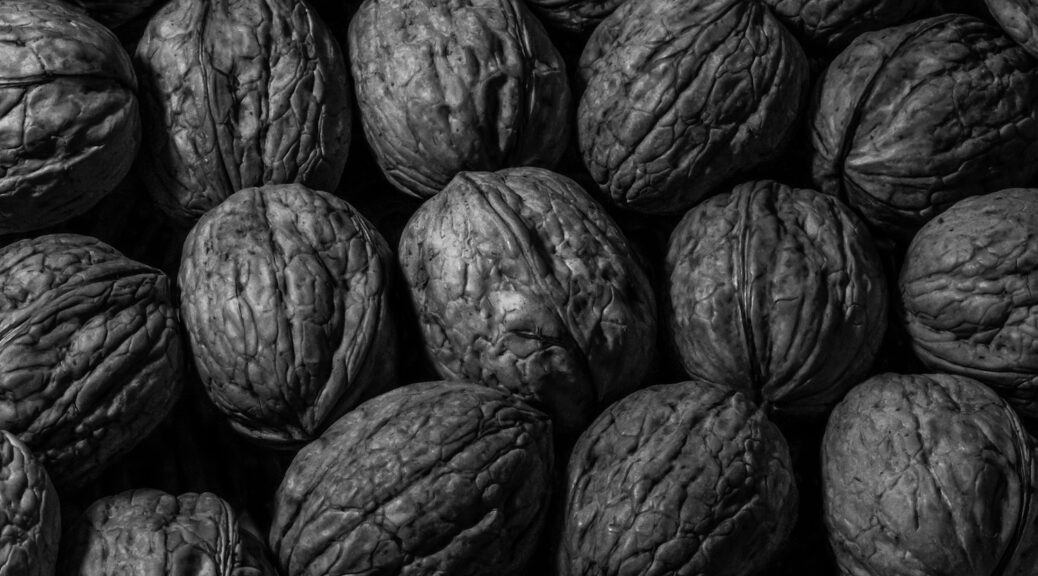
Recipes Using Native Black Walnuts
Black walnuts are native to the eastern and midwestern U.S. The English walnut wasn’t cultivated in the U.S. until around 1870, in California.
Black walnuts have a different taste from Engish walnuts. I especially like black walnut ice cream, and I use them in baked goods or add them to my homemade trail mix.
Black walnuts grow with a green outer coating on them. This coating has to be removed before the hard nut inside can be reached. The outer coating turns black and mushy the longer it stays on the ground. The nut is so hard, it can’t be cracked with a regular nut cracker; it has to be cracked with a hammer.
The only company I know of that sells shelled black walnuts is Hammons. It’s definitely worth buying them rather than gathering them from the ground and cracking them yourself.
When the nut is small and immature, though, the outer coating can remain on the nut, which can be pickled or used to make catsup.
INFORMATION BELOW FROM 1800s COOKBOOKS
Walnuts, to be well masticated, have been given to gouty and rheumatic patients with great success. About one dozen per day is the quantity prescribed. It is possible that herein lies the secret of the fact that our ancestors invariably took walnuts with their wine. The green, unripe walnut is useful for expelling worms. Butternuts* and black walnuts blanch more easily than the English walnut.
*butternut – also called white walnut, a species of walnut native to the eastern U.S. and southeast Canada.
BLACK WALNUT AND POTATO MOUND
Mix one quart nicely seasoned, well beaten mashed potato, one cup chopped black walnut meats, and 3 tablespoons grated onion. Pile in a rocky mound on a baking pan or plate. Sprinkle with crumbs or not. Bake in a quick oven until delicately browned. Garnish and serve with a sauce or gravy of your preference.
WALNUT AND CELERY SALAD
Take three cups of fresh, crisp celery cut fine and two cups of walnuts, carefully shelled that they may be as little broken as possible. Put the walnuts in a saucepan with a small onion sliced, a bay leaf, a clove and twelve pepper corns. Cover with boiling water, let them cook for ten or fifteen minutes, remove from the fire, drain and throw the nuts into cold water. Remove the skins and let them get cold, then set on the ice until it is time to serve. Mix them with the celery, add mayonnaise or cream dressing, put on a dish or in a salad bowl, garnish with the tender green celery leaves and serve.
WALNUT CROQUETTES
Put half a pint of bread crumbs and a gill* of milk in a double boiler. Place over the fire and stir until thick and smooth. Add a pinch of salt, three-quarters cup of chopped nuts and a tablespoon of sherry. When the mixture is hot, stir into it the well-beaten yolks of two eggs and remove from the fire at once. Set the mixture away to get cold, then form in any shape preferred for croquettes. Dip them in egg and then in dried bread or cracker crumbs, fry in boiling fat and serve with a sauce piquante.
*gill or jill – a liquid measurement; four ounces (1/2 cup) in the U.S. and five ounces in the U.K.
WALNUT CHEESE
Take a pint of nice walnut kernels and pound them in a mortar with two teacups* of brown sugar and a tablespoon of water. Put it in cups or small bowls and it will turn out like other cheese. It is a favorite refreshment with some country children.
*teacup – same as a jill or gill; four ounces (1/2 cup) in the U.S. and five ounces in the U.K.
TO PICKLE BUTTERNUTS AND WALNUTS
The nuts for pickling should be picked as early as the first of July unless the season is very backward. If a pin will go through them easily, they are in a right state for pickling. Soak them in salt and water for a week, then drain, and scrape or rub them with a cloth. Sprinkle them with ground cloves and pour on boiling vinegar, spiced with cloves, pepper corns, allspice, and mace. Add a little salt. They will be fit to eat in the course of a fortnight* or three weeks. The vinegar they are pickled in makes a nice catsup, if boiled down to half the quantity, and a little more spice added.
*fortnight – a period of two weeks.
WALNUT PICKLE
Be particular in obtaining them exactly at the proper season; usually in early July. The walnuts should be very young and tender, so that you may pierce them through with a needle.
Steep them a week in brine*. If they are wanted to be soon ready for use, prick them with a pin, or run a larding pin several times through them. But if they are not wanted in haste, this method had better be let alone.
Put them into a kettle of brine and give them a gentle simmer, then drain them on a sieve and lay them on fish drainers in an airy place until they become black, which may be two days.
Then add hot pickle of one quart vinegar in which has been steeped in the proportion of one ounce each black pepper, ginger, shallots, salt, and mustard-seed.
Boil it up, allowing to each quart four or six anchovies chopped small, and a large tablespoon of shallots, also chopped. Let it stand a few days till it is quite clear, then pour off and bottle. It is an excellent store sauce for hashes, fish, and various other purposes.
*brine – water saturated with salt.
WALNUT CATSUP
Gather them when they are young and green. Prick them with a large needle and let them lie three days in an earthen pan, sprinkled with a handful of salt and a very little water. Mash them well each day with a rolling pin. On the fourth day, pour some scalding hot salt and water over, mash again, and let them stand the whole day. Then with a spoon or cup, lift out what liquor there is, pound the walnuts well, and pour a little good vinegar and water over them, which will extract all their juice. Pour this off, and put to it what you already have, boil it slowly, and skim well.
When there is no longer any scum, put to every quart one ounce each bruised ginger, allspice, and black pepper, and one-fourth ounce each of cloves, mace, and nutmeg. Simmer three-fourths of an hour and when cold, bottle it.
=================================================
Have You Ever Eaten Black Walnuts? Please Leave a Comment Below.
=================================================
2 thoughts on “Recipes Using Native Black Walnuts”
Thanks for some other ideas on using black walnuts! Black walnut ice cream is my favorite and I can’t find it anywhere around here.
It’s a seasonal ice cream where I live. I can only find it in the winter. You could buy vanilla ice cream, put it in a big bowl and mix in chopped black walnuts yourself. That should be fairly close to commercial black walnut ice cream.