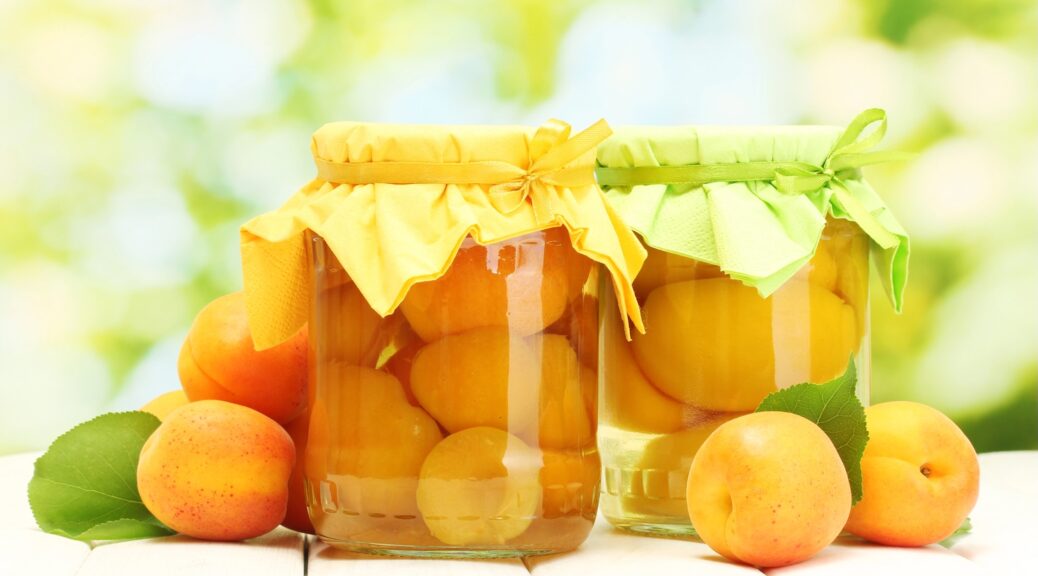
How to Pickle Fresh Fruit
Home canning wasn’t popular until the Mason jar was invented in 1858. It had a screw-on threaded rim and metal lid with a rubber seal. Now, rather than relying on the traditional method of pickling or salting food and storing it in large stone crocks, food could be canned and in smaller quantities.
PLEASE NOTE: if any of the recipes below sound interesting, use a modern cookbook for canning directions. The instructions below are a bit vague and may not be safe by today’s standards.
INFORMATION BELOW COMPILED FROM 1800s COOKBOOKS
PICKLED PLUMS or DAMSONS
The fruit must be large, fine, fully ripe, and with no blemishes. To every quart of plums, allow one-fourth pound of loaf-sugar powdered, and a pint of the best cider vinegar. Damsons being more acid will require half a pound of sugar. Put the fruit with the sugar and vinegar into a preserving kettle, adding little bags with some broken pieces of cinnamon and some blades of mace, and, if you choose, a few cloves. Give them one boil up, and skim them well. Put them warm into stone jars and cover them closely at once. By winter they will be fit for use.
Another way.—Is to pack a jar more than three-fourths full with layers of ripe plums or damsons; and thick layers of powdered sugar between. Fill up with cold vinegar, and cover them tightly.
PICKLED CHERRIES
Take large, fine, red cherries, perfectly ripe, and cut the stems about an inch long. Put the cherries into jars with layers of powdered sugar between each layer of fruit, interspersing them with little, thin muslin bags of broken cinnamon, mace, and nutmeg. The jars should be three-fourths full of cherries and sugar. Fill up with cold vinegar, and cover them close.
PEACH PICKLES
Stir two pounds of white sugar into two quarts of the best cider vinegar. Boil it ten minutes, skimming it well. Have ready some large fully-ripe peaches. Rub them with a clean flannel to take off the down, and stick four cloves into each. Put them into glass or white-ware jars, (rather more than half-full,) and pour on them the boiling hot vinegar. Cover them closely, set them in a cool place, and let them rest for a week. Then pour off the liquid, and give it another boiling. Afterwards pour it again on the peaches. Cover them closely, corking the jars, and tying leather over each, and put them away till wanted for use.
Instead of cloves you may stick the peaches with blades of mace, six blades to each peach.
Apricots may be pickled as above. Morella cherries also, using mace instead of cloves.
FINE PEACH MANGOES
Take fine, large, free-stone peaches. They should be ripe, but not the least bruised. The best for this purpose are the large white free-stones. Having rubbed off the down with a clean flannel, cut the peaches in half and remove the stones.
Prepare a mixture in equal portions of mace, nutmeg, and root-ginger, all broken up small, but not powdered. Fill the cavities of the peaches with this whence the stones were extracted. Then put together the two halves of each peach, (making them fit exactly,) and tie them round with coarse thread or fine twine. If you choose, you may stick the outside of the peaches all over with cloves. Put them into stone jars, filling each jar rather more than three-fourths full, and laying among them little thin muslin bags of turmeric to color them yellow. If you prefer to color them red, tie up some cochineal* in thin muslin bags.
Fill up the jars to the top with cold vinegar of the best quality—real white wine vinegar, if you are sure it is real. If the pickles are to be sent to a distant place, or to a warmer climate, boil the vinegar and pour it on, scalding hot. Close the jars immediately; sealing the corks with red cement, and tie a bladder *tightly over the top of each.
These peach mangoes will be fit for use in two months.
*cochineal – a red dye for coloring foods made of the dried and pulverized bodies of female cochineal insects.
*bladder – the bladder from an animal was used to cover mincemeat, potted meat, etc., to exclude the air.
STRAWBERRY PICKLE
Ingredients: Seven pounds of strawberries, three and one-half pounds of brown sugar, one and one-half pints of cider vinegar, one ounce cloves, and one ounce of stick-cinnamon. Place the strawberries and spices in alternate layers in a deep dish. Boil the sugar and vinegar three minutes, and pour it over them, letting them remain until the next day. The second day, pour the liquor off and boil it again three minutes, returning it as before, to the strawberries. Let them remain until the third day, then boil all together over a slow fire for half an hour. Put it away in jars.
FINE LEMON PICKLE
Take some fresh ripe lemons, and (having first rolled each one under your hand upon the table) cut them into quarters, and remove all the seeds. Put the pieces of lemon with all the juice into a stone jar. Have ready a sufficient quantity of excellent vinegar to cover the lemon well. Boil the vinegar with a clove or two of garlic, some blades of mace, a broken up nutmeg, whole pepper, (the white or peeled pepper-corns will be best;) some cayenne and a very little salt. The proportion of these ingredients may be according to your taste, but the seasoning should be high, yet not so as to overpower the lemon-flavor. Having boiled the vinegar with all these articles about ten minutes, pour the whole boiling hot upon the lemon in the jar, and immediately cover it closely.
Let the jar stand three weeks in the chimney-corner, stirring it frequently, and setting it occasionally in the oven after the baking is done. Then roll a sheet of blotting paper into a cone, pinning up the side, and folding the cone so as to close up the pointed end. Have ready some small clean black bottles. Set the paper cone into the mouth of the bottle, and through it filter the liquid. Seal the corks. This will be found an excellent sauce for fish, or any sort of white meat; and will keep for years.
=================================================
Have You Ever Eaten Pickled Fruit? Please Leave a Comment Below.
=================================================