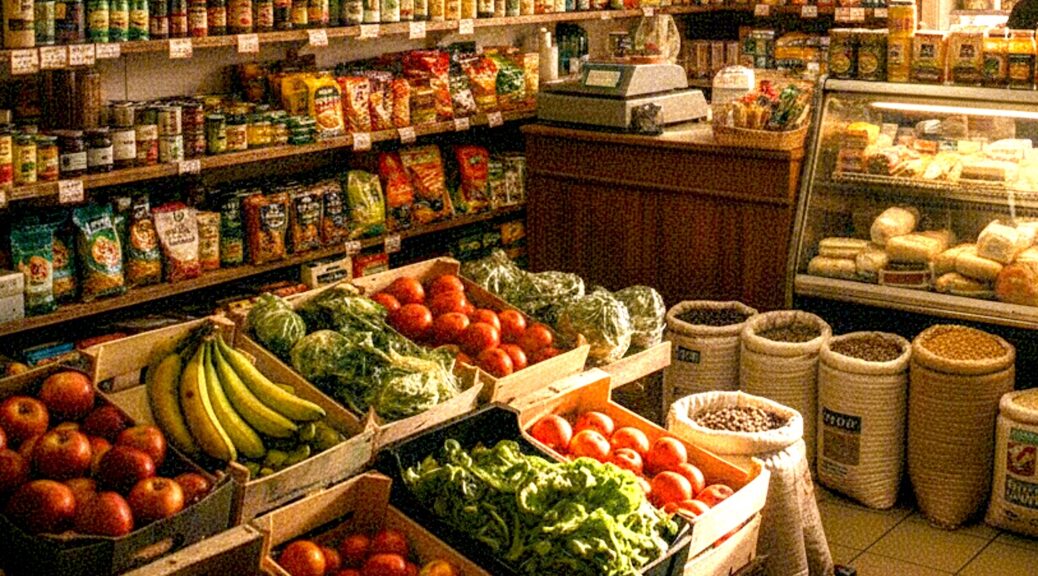
Grocer’s Goods – A Family Guide 1888
It’s interesting to read of the “new” grocery items that became available in grocery stores in the late 1800s. Previously penople had to preserve most of their food and only have fresh produce in season. This booklet also claims grocery prices have never been lower.
The information in this post is compiled from a booklet called:
GROCER’S GOODS:
A FAMILY GUIDE
TO THE PURCHASE OF
Flour, Sugar, Tea, Coffee, Spices,
Canned Goods, Cigars, Wines,
AND ALL OTHER ARTICLES
Usually Found in American Grocery Stores.
By F. B. GODDARD, 1888.
You can read the entire booklet on the Project Gutenberg website for free at this link: https://www.gutenberg.org/files/50759/50759-h/50759-h.htm
A FAMILY GUIDE
In the ancient times of twenty-five or thirty years ago, the grocer’s goods consisted chiefly of codfish, flour, sugar, tea, coffee, salt, molasses and whale oil. There was also a little candy in glass jars, some nuts in bins, a few drums of figs and a box of sour oranges. The grocer himself found plenty of time to talk politics and play checkers across the counter with his friends and neighbors. Those were the days when a few conservative old merchants used to meet and discuss the tea market and allot among themselves the quantity to be imported, not a pound of which could arrive under twelve or fifteen months.
But things have changed. The importer now flashes his order under the sea and on, over plains and through jungles to China. “Ocean tramp” steamships are waiting to receive his merchandise, and within thirty or forty days it may be sending up its grateful fragrance from tea tables in the Mississippi Valley.
THE MODERN GROCER.
Nor has the enterprising retail grocer of to-day failed to catch the spirit of this progress and keep even step with it. He has become the Popular Food Provider, and his store represents about everything which is palatable in either hemisphere or any zone. As the world has grown enlightened and refined, his stock has become more and more varied and better adapted to the wants of mankind, until it embraces every delicacy of the land, sea or air.
His cunningly prepared sauces provoke the appetite and give zest to more substantial articles, while they help also to digest them. He has food fitted for the intellectual worker and for the laborer, for the invalid and for the infant. He practically annihilates the seasons and furnishes fruits and vegetables in mid-winter, as fresh and delicate as when first plucked from their native stems or vines. And, moreover, all the goods upon his sightly shelves are now put up in the most attractive, portable and convenient form for family use.
FOOD NEVER BEFORE SO LOW
Nor would a day’s wages ever before purchase so much of food products. In the English market, for the ten years from 1870 to 1880, the price of wheat was forty-three per cent. higher than the average of 1886. Sugars have fallen in price nearly one-half in ten years, and teas, coffee, and many other articles are proportionately low.
This is due to improvements in machinery, increased transportation facilities and the opening up of new and fertile sections of the earth, under all of which the world’s supply of food has of late years been greatly in excess of the world’s increase in population; and it is the grocer who brings these advantages home to our families.
HINTS TO HOUSEKEEPERS
As a rule, whole or unground articles are to be preferred to those which are powdered; not only because they are less liable to adulteration, but also because the latter more quickly lose flavor and strength.
This objection applies also to buying goods in large quantities of wholesale dealers, for family use. This plan may appear to be economical, but is generally disadvantageous both to buyer and seller. Tea, aromatic and ground goods, and many other commodities often deteriorate in quality before they are used. Servants who can dip their hands into abundant supplies are apt to become more wasteful. If articles so purchased do not prove suitable, it is more trouble to exchange them than with the retail dealer who sells in smaller quantities and is in daily contact with his customers. And, besides, an honest man who studies the daily wants of the families of his community, and adapts his business to supplying them with good articles in convenient quantities and at fair prices, has a right to expect consideration and encouragement from his friends and neighbors.
VARIETY IN FOOD
If any constituent is deficient we must supply it; hence variety in food is not only agreeable but necessary to health. Albumen, fibrin, casein and gluten build up the muscles and tissues, while starch, sugar and fat produce the warmth and energy of the body. The mineral substances are necessary for the framework—the bones. Grains, fruits and vegetables contain starch and sugar and more or less gluten; meats contain fibrin and albumen; milk, casein, etc.
BREAD
One hundred pounds of good, fine, wheaten flour will take up forty-five pounds of water, and yield one hundred and forty-five pounds of bread. The proper and legal weight of bread is while it is hot. A four-pound loaf loses in twenty-four hours one and one-fourth ounces; in forty-eight hours five ounces; in seventy hours nine ounces. The quantity of water which flour will absorb depends largely on the proportion and quality of the gluten. The best flours absorb most, and will take up more in dry than in wet seasons; hence a dry season is good for the baker. Thorough kneading increases the absorption of water, and should be continued until none of the dough will stick to the hand.
EXCELLENCE OF AMERICAN CANNED GOODS
M. Appert, of France, first patented (in 1810) a process for preserving animal and vegetable substances in close vessels of glass—after subjecting them to the action of heat—and an English firm soon after introduced provisions preserved in tin. But it was reserved for Americans to lead the world, not only in the magnitude of their canning industries, but also in the art of preserving meats, vegetables, and fruits, by processes so delicate and effective, as to retain their original shape and texture, as well as their freshness and flavor. And, moreover, while they have practically prolonged the “Seasons” for perishable food products throughout the entire year, and furnish them for the consumer at very reasonable rates, the producer has often thanked them for giving stability to prices in seasons of great “Gluts” and abundance.
SPICES AND CONDIMENTS
Spices are generally understood to be more aromatic and fragrant and less pungent than what are called condiments. Spices are usually added to sweetened food, while condiments, as pepper and mustard, are better suited to meats and food containing salt.
It is impossible to supply genuine articles if the public are not willing to pay for them, and it may be accepted as a general rule, that the lower the price of ground spices and condiments, the more they are adulterated. The materials chiefly used for this purpose are starch, cracker dust and similar harmless substances, and the mixture usually contains as much of the pure material as can reasonably be afforded at the price it sells for. The purchaser may elect whether he will have such articles, or those which are genuine at a higher cost. The grocer does not create wants and demands; he merely supplies them.
SALT
Common Salt varies in purity and sometimes contains salts of lime, magnesia, and potash. But as those are more soluble in water than common salt, it is easy to remove them in the process of manufacture. Our culinary salt comes from several sources; rock salt deposits or mines, sea water, and salt springs.
There are numerous brands of salt which are freed from all impurity, ground to various degrees of fineness, and put up in barrels, sacks, bags and packets of all sizes; also in stone jars.
VINEGAR
The sour principle is acetic acid, of which good vinegar contains about four per cent. Vinegar may be obtained by fermentation from the juice of any starchy or sweet fruit or vegetable, from beer, or even from sweetened water, to which “mother” or other vinegar is added. Cider vinegar is most used, as it retains the fruity flavor of the apple, but good vinegar is also made from wine, malt, oranges, raspberries, &c. in many varieties in market, both domestic and foreign. Stringent laws regulate the purity and strength of vinegar for domestic uses, in New York and some other states.
FRESH VEGETABLES
In the Spring and Summer months the appetite craves fresh vegetables; and their free use, especially in those seasons, will be found excellent for the general health of the family. Spinach, for instance, is said to be beneficial in kidney complaints; Dandelion greens are good for biliousness; Tomatoes act upon the liver; Celery upon the nerves; Onion soup restores a debilitated stomach, &c. In fact, it would be easy thus to go through the whole vegetable list and find each one possessing some special mission of healthfulness.
WHERE EARLY VEGETABLES COME FROM
The Bermudas send annually about $400,000 worth of potatoes, onions, beets and tomatoes to New York, during the months of March, April and May. Florida garden produce finds its way North very early in the Spring, and later, in regular order, Georgia, South and North Carolina, and Virginia, wheel into line with their numerous productions, until, finally, our home gardeners have their season. During all this time our vegetables on sale are improving in freshness as they are drawn from sources nearer home, and prices are falling.
BEANS, PEAS, AND LENTILS
These leguminous seeds are very nutritious and palatable, and rank high among strength-giving foods. They contain vegetable casein in place of gluten, and hence are not suitable for making bread; all these articles are more digestible if eaten with fat, and the American staple dish of Pork and Beans is really the marriage of two articles which agree very well with each other. Dried Peas, split, or ground into meal, are much used for soups. Lentils, which are round seeds like flattened peas, are excellent used as a vegetable, but are comparatively little known. The most popular varieties of the white beans are the Marrow, Kidney and Pea beans. There are also Frijoles or black beans, Lima beans, etc.
DRIED FRUITS
The chief consideration with articles in this line is, that they should be as fresh as possible, and free from vermin and traces of vermin. Worms in dried fruits are never in sight, even though they may swarm below the surface. Dried Apples should be light colored, plump and acid. Evaporated fruit (by the Alden process, etc.) is preferred to sun-dried. It is often bleached in the fumes of sulphurous acid, which has a tendency to keep the fruit free from worms, and does not injure the flavor. Dried Peaches should be pealed, clear and dark. Dried Plums should be pitted, clear and bright. Dried Berries—the chief danger is from worms.
NUTS
Almonds are of two kinds, the sweet and bitter; the latter are only used for making extracts. Among the edible varieties are the Tarragona, Valencia, “Jordan,” a corruption of Jardin (garden), etc. There are hard, soft, and “paper shell” almonds, and almond meats freed from their shells. Filberts are cultivated hazel nuts and come mainly from Sicily. Pecans come from Texas. Walnuts from Italy, France, and Chili. Brazil Nuts grow along the Amazon in clusters on high trees. They are oily and rich. Peanuts come from Virginia, and Chestnuts from Italy and our own Northern States.
=================================================
Have Do You Think of the New Groceries Available in the late 1800s?
Please Leave a Comment Below.
=================================================